Hello world!
💙 from Vietnam

A flexible platform to build your digital headquaters

🔹Kéo thả các miếng Lego Nocode tạo ra tính năng nghiệp vụ theo nhu cầu, không cần code đâu.
🔹Xoá bỏ rào cản kỹ thuật, ai cũng tự làm được tính năng mình cần, cho việc mình làm, chả phải đợi ai.

dùng thật thì 90k / người / tháng
nocode & lowcode
workflow & automation
unified chat & work data

A flexible platform to build your digital headquaters

Luklak is a two-layer architecture that lets you build, govern, and operate
your entire business—unified, universal, and completely yours.
Build Layer (Layer 1) – Your Construction Toolkit

Designing unique operational applications.

Explore the Build Layer
Ground Layer (Layer 2) – Your Governance

Foundation Defining who works in your building (Roles) and what they can do (Permissions).

Explore the Ground Layer

Flexible data fields

You get access to an array of standard and advanced fields, allowing you to capture any information structure.
Checkbox
Multi Checkbox
Text
Text area
Formula
Data table
Single select
Multi select
Single group
Multi group
Integer
Currency
Decimal
Percent
Date picker
Date time
Single user
Multi user
Single email
Multi email

Layer 1: The Build Layer

It is a three-tiered architectural process
designed for NoCode and LowCode users to define, design,
and deploy operational logic across the entire business.

This first tier provides the raw, pre-engineered capabilities that make Luklak unified. Every function you build relies on these 9 components, which all share the DNA of the Universal Object.

  • Foundation: Universal Object, Data Fields, Object Connections
  • Process: Universal Workflow, Universal Automation
  • Experience: Unified Livechat, Workviews & Dashboards, UQL, Permissions & Notifications

These components function as advanced LEGO® blocks, capable of unlimited combinations because they were engineered to snap together perfectly from the start.

Drag-n-drop

The second tier is the design phase. A Function is the single master blueprint where the architect (you) assembles and configures the 9 components to solve a specific business problem, without having to code

  • Design Environment: This tier provides the canvas to define Object Types (e.g., Customer, Project, Asset), configure their specific Data Fields, design the Universal Workflow flow, and set the Permission Schemes.
  • Reusable IP: A Function is reusable and in the background—it is the plan, not the live work. You design it once, and it serves as the standardized process for your entire team.

The third tier is where the blueprint is deployed for execution, forming the actual work environments that users interact with daily.

  • Space: A Space is the living, breathing environment created from a Function. It is the container where teams interact with Objects and execute the designed process.
  • The Three Perspectives: The user environment is composed of three interconnected views of the same data: 

    🔹Organizational Structure
    🔹Workspaces
    🔹Personal Home 
Chat trực tiếp trên đầu việc

Live chat trao đổi trực tiếp được trên mọi đầu việc, dữ liệu và các đối tượng tính năng tạo ra trên hệ thống. Thông tin dữ liệu ở đâu, thông tin chat liền mạch ở đó luôn, không phải mang ra chỗ khác để chat.

Duy nhất trên thế giới chỉ mình Luklak có.

Chat theo cấu trúc phòng ban, mảng việc

Các kênh chat được thiết kế chặt chẽ dành cho doanh nghiệp. Việc thuộc phòng ban, mảng việc nào thì chat đúng chỗ, tương tác với đúng người.
Tương tự như Slack & Microsoft Teams.

Chat riêng cá nhân, nhóm

Với những công việc riêng tư, không muốn gắn vào cấu trúc tổ chức hoặc công việc, bạn hoàn toàn có thể chat riêng 1-1 hoặc chat nhóm với Luklak.

Tương tự Zalo, Messenger.


convert chat to task
pin chat
star message

Where work and conversation become one.

Stop chasing context across scattered apps. Luklak eliminates the cost of fragmentation by unifying structured work data with unstructured discussions, providing a seamless, focused experience.

The Unified Data Foundation

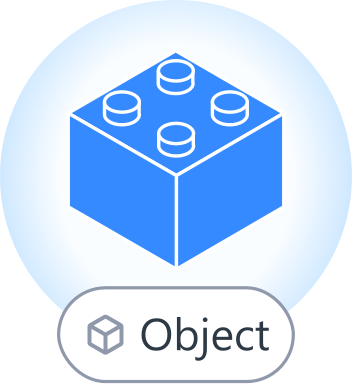
This is the architectural blueprint for every entity you create. All Objects inherit native capabilities, ensuring compatibility across all platform functions, and serve as the core entity linked by Object Connections.

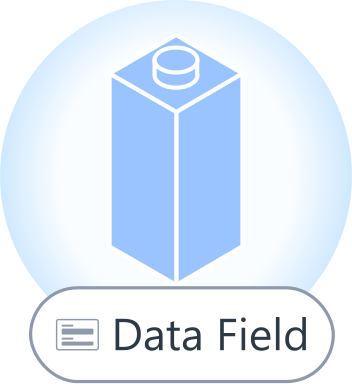
Capture Information and Logic

Captures custom business information, including complex calculation logic. This data is the source material for UQL queries and fuels conditional execution in Automation.

Standardize Process and Flow

This visually defines the standardized process lifecycle (Statuses and Transitions) for any Object. State changes are the primary trigger for conditional execution in Universal Automation rules.

Map Business Relationships

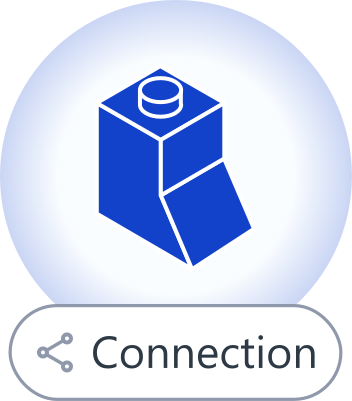
Establishes native, bidirectional links between any Objects (e.g., Customer to Contract). This structure allows UQL to instantly traverse complex hierarchical data for reporting without ETL.

Contextual Team Collaboration

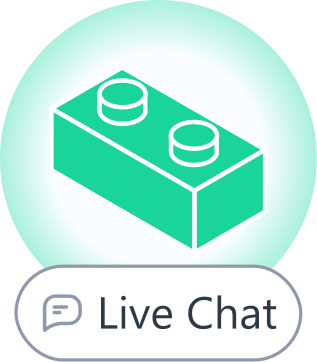
Integrates unstructured conversation directly onto the Object, making context visible. History is governed by Permissions and can be used to notify teams of Automation results.

Orchestrate Cross-Functional Action

This is the cross-functional engine that executes actions based on defined triggers. It relies on Workflow changes and Data Field values to orchestrate complex handoffs between Connected Objects.

Dashboard

The front-end visualization layer for processes and analytics. It displays results from UQL queries and allows users to interact with Objects based on their Workflow status (Kanban, List, Timeline).

Access All Data Instantly

The native, real-time query language that accesses all data across the platform. It eliminates ETL for reporting by instantly traversing Object Connections.

Secure Access and Alert

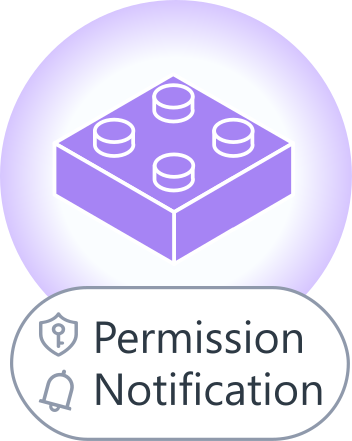
The governance structure that controls user access and information flow. Defines Roles and dictates who can view, edit, or delete Objects, Data Fields, and Livechat discussions.
Build your own digital HQ

Browse our library of pre-built, ready-to-deploy Functions & Solutions.
Start from 90%, not from scratch.

Lego #1 – Universal object

Visualize work exactly how your teams need to see it

The core blueprint for every entity you create. All Objects inherit native capabilities, ensuring seamless compatibility across the platform.

Lego #1 – Universal object

Visualize work exactly how your teams need to see it

The core blueprint for every entity you create. All Objects inherit native capabilities, ensuring seamless compatibility across the platform.

Lego #1 – Universal object

Visualize work exactly how your teams need to see it

The core blueprint for every entity you create. All Objects inherit native capabilities, ensuring seamless compatibility across the platform.

Lego #1 – Universal object

Visualize work exactly how your teams need to see it

The core blueprint for every entity you create. All Objects inherit native capabilities, ensuring seamless compatibility across the platform.

Lego #1 – Universal object

Visualize work exactly how your teams need to see it

The core blueprint for every entity you create. All Objects inherit native capabilities, ensuring seamless compatibility across the platform.

Lego #1 – Universal object

Visualize work exactly how your teams need to see it

The core blueprint for every entity you create. All Objects inherit native capabilities, ensuring seamless compatibility across the platform.

Lego #1 – Universal object

Visualize work exactly how your teams need to see it

The core blueprint for every entity you create. All Objects inherit native capabilities, ensuring seamless compatibility across the platform.

Lego #1 – Universal object

Visualize work exactly how your teams need to see it

The core blueprint for every entity you create. All Objects inherit native capabilities, ensuring seamless compatibility across the platform.

    1 Out-of-the-box softwares
    These offer high simplicity and rapid deployment but are severely limited in configuration. You hit the “Simplicity Tax” immediately when your unique business process evolves.
    2 No-code & Low-code (Luklak)
    This category provides architectural flexibility and speed. It allows business users to design custom solutions without code, eliminating the complexity tax.
    3 Custom-code
    This offers maximum flexibility, achieving true architectural freedom. However, it incurs the highest cost, risk, and technical debt due to long development cycles and maintenance.
    4 Big ERP systems
    These systems offer vast scope and functional depth. They impose the highest complexity tax, requiring expensive specialized administrators and rigid, legacy architectures.
    Out-of-the-box softwares
    These offer high simplicity and rapid deployment but are severely limited in configuration. You hit the “Simplicity Tax” immediately when your unique business process evolves.
    No-code & Low-code (Luklak)
    This category provides architectural flexibility and speed. It allows business users to design custom solutions without code, eliminating the complexity tax.
    Custom-code
    This offers maximum flexibility, achieving true architectural freedom. However, it incurs the highest cost, risk, and technical debt due to long development cycles and maintenance.
    Big ERP systems
    These systems offer vast scope and functional depth. They impose the highest complexity tax, requiring expensive specialized administrators and rigid, legacy architectures.
    Out-of-the-box softwares
    These offer high simplicity and rapid deployment but are severely limited in configuration. You hit the “Simplicity Tax” immediately when your unique business process evolves.
    No-code & Low-code (Luklak)
    This category provides architectural flexibility and speed. It allows business users to design custom solutions without code, eliminating the complexity tax.
    Custom-code
    This offers maximum flexibility, achieving true architectural freedom. However, it incurs the highest cost, risk, and technical debt due to long development cycles and maintenance.
    Big ERP systems
    These systems offer vast scope and functional depth. They impose the highest complexity tax, requiring expensive specialized administrators and rigid, legacy architectures.
    Customer
    These offer high simplicity and rapid deployment but are severely limited in configuration. You hit the “Simplicity Tax” immediately when your unique business process evolves.
    Meeting
    This category provides architectural flexibility and speed. It allows business users to design custom solutions without code, eliminating the complexity tax.
    Contract
    This offers maximum flexibility, achieving true architectural freedom. However, it incurs the highest cost, risk, and technical debt due to long development cycles and maintenance.
    Ad
    These systems offer vast scope and functional depth. They impose the highest complexity tax, requiring expensive specialized administrators and rigid, legacy architectures.
    Customer
    These offer high simplicity and rapid deployment but are severely limited in configuration. You hit the “Simplicity Tax” immediately when your unique business process evolves.
    Meeting
    This category provides architectural flexibility and speed. It allows business users to design custom solutions without code, eliminating the complexity tax.
    Contract
    This offers maximum flexibility, achieving true architectural freedom. However, it incurs the highest cost, risk, and technical debt due to long development cycles and maintenance.
    Ad
    These systems offer vast scope and functional depth. They impose the highest complexity tax, requiring expensive specialized administrators and rigid, legacy architectures.
    Customer
    These offer high simplicity and rapid deployment but are severely limited in configuration. You hit the “Simplicity Tax” immediately when your unique business process evolves.
    Meeting
    This category provides architectural flexibility and speed. It allows business users to design custom solutions without code, eliminating the complexity tax.
    Contract
    This offers maximum flexibility, achieving true architectural freedom. However, it incurs the highest cost, risk, and technical debt due to long development cycles and maintenance.
    Ad
    These systems offer vast scope and functional depth. They impose the highest complexity tax, requiring expensive specialized administrators and rigid, legacy architectures.
    Customer
    These offer high simplicity and rapid deployment but are severely limited in configuration. You hit the “Simplicity Tax” immediately when your unique business process evolves.
    Meeting
    This category provides architectural flexibility and speed. It allows business users to design custom solutions without code, eliminating the complexity tax.
    Contract
    This offers maximum flexibility, achieving true architectural freedom. However, it incurs the highest cost, risk, and technical debt due to long development cycles and maintenance.
    Ad
    These systems offer vast scope and functional depth. They impose the highest complexity tax, requiring expensive specialized administrators and rigid, legacy architectures.

    Flexible data fields

    You get access to an array of standard and advanced fields, allowing you to capture any information structure.
    Customer
    These offer high simplicity and rapid deployment but are severely limited in configuration. You hit the “Simplicity Tax” immediately when your unique business process evolves.
    Meeting
    This category provides architectural flexibility and speed. It allows business users to design custom solutions without code, eliminating the complexity tax.
    Contract
    This offers maximum flexibility, achieving true architectural freedom. However, it incurs the highest cost, risk, and technical debt due to long development cycles and maintenance.
    Ad
    These systems offer vast scope and functional depth. They impose the highest complexity tax, requiring expensive specialized administrators and rigid, legacy architectures.
    Customer
    These offer high simplicity and rapid deployment but are severely limited in configuration. You hit the “Simplicity Tax” immediately when your unique business process evolves.
    Meeting
    This category provides architectural flexibility and speed. It allows business users to design custom solutions without code, eliminating the complexity tax.
    Contract
    This offers maximum flexibility, achieving true architectural freedom. However, it incurs the highest cost, risk, and technical debt due to long development cycles and maintenance.
    Ad
    These systems offer vast scope and functional depth. They impose the highest complexity tax, requiring expensive specialized administrators and rigid, legacy architectures.

    Thay thế được

    Jira
    Notion
    Slack
    Scroll to top