


TL;DR: Slack discussions vanish into general channels. Critical decisions get buried in DMs. Unified Livechat attaches conversation directly to work objects—preserving context, decisions, and institutional memory where they matter.
“Why did we choose vendor B again?”
Nobody remembers. The conversation happened somewhere in Slack, six months ago, buried between 4,000 other messages. Your brain knows the decision was made. The reasoning? Gone.
The Divorce of Talk and Work
We have accepted a bizarre architecture for modern work:
- The Work lives in structured databases (CRM, Project Tools, ERP).
- The Talk lives in ephemeral streams (Slack, Teams, Email).
This separation imposes a “Context Tax” on every employee.
When you see a task labeled “URGENT” in your project tool, you don’t know why it’s urgent. You have to switch to Slack to find the context. When you see a deal stage move to “Negotiation” in your CRM, you don’t know what the blockers are. You have to email the rep to ask.
Your team spends half their day simply bridging the gap between where the data sits and where the decisions happen.
When talk is temporary—detached from the work it concerns—your organization pays four hidden taxes.
The Four Hidden Taxes of Temporary Communication
- The Toggling Tax. Knowledge workers switch between applications 1,200 times per day, spending 9.5% of their time navigating between tools. But the real cost isn’t the switching—it’s context reconstruction. Every jump from Slack to your project tool requires rebuilding mental context. Which project were we discussing? What was decided? Your brain burns energy translating between systems.
- “I Didn’t Say So.” Important decisions happen in general channels. Six months later, nobody remembers why the pricing changed—only that it changed. Someone asks, “Why did we choose vendor B?” The conversation is buried somewhere in #general between 4,000 other messages. Institutional memory evaporates because decisions aren’t attached to the work they affect.
- “I Didn’t Know.” Real work happens in DMs. The critical debate about scope change? Private thread between two people. Leaders see the “Done” status but miss the trade-offs that led there. The system records outcomes, not reasoning. When decisions live in side channels, organizational intelligence degrades.
- “It’s a Matrix.” New team members inherit current status but lack history. They waste months relearning lessons the team already solved—because context is locked in closed Slack channels and departed employees’ message archives. Onboarding becomes archaeological excavation instead of knowledge transfer.
Conversation as Permanent Record
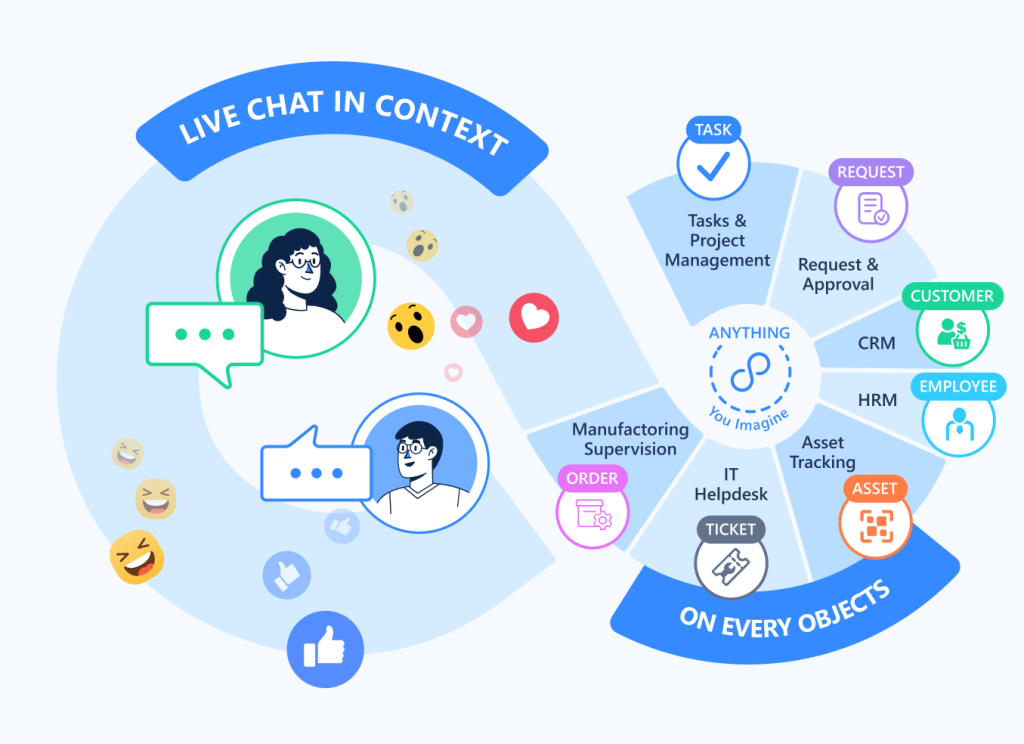
Unified Livechat inverts the model. Instead of treating communication as temporary—something that happens in channels and then disappears into scroll-back—conversation becomes part of the permanent work record.
Open a customer record. The discussion thread lives there—every conversation about this customer, visible to anyone with access. Open a project. The project chat appears—every decision, every question, every status update, permanently attached.The work and its conversation history occupy the same space.
At LAIKA, this transformed how institutional memory works. When someone asks about the Miley Construction project, they open the project object. The entire discussion history is there: initial scope conversation, the debate about material choices, the decision to extend timeline, the client feedback on design drafts.
Six months later, a similar project starts. The team opens the Miley project, reads the chat history, and learns from decisions already made. Organizational intelligence compounds instead of resetting.
How Permanent Context Works
Every Universal Object—customer, project, task, invoice, support ticket—includes native conversation threading:
- Thread per object. Each work object maintains its own discussion history. Customer #4132 has its conversation record. Project #826 has separate discussion. Context stays attached to the work it concerns.
- Visibility by permission. See the customer object? You see its conversation history. Permission inheritance is automatic. No separate channel management.
- Automatic context inheritance. Open a task within a project. You can see both task-level discussion and parent project and the customer connected. Understanding flows above and beyond your silos.
- Rich work artifacts. Share files directly in object conversation. They attach to the object permanently. Create task assignments without leaving the discussion. Mention users with @-notifications that link directly to the work item.
Decision archaeology becomes instant. Six months later, someone asks, “Why did we choose this approach?” Open the project. Scroll the conversation thread. The discussion where that decision happened appears—complete with the rationale, alternatives considered, and trade-offs accepted.
The Intelligence of Visibility
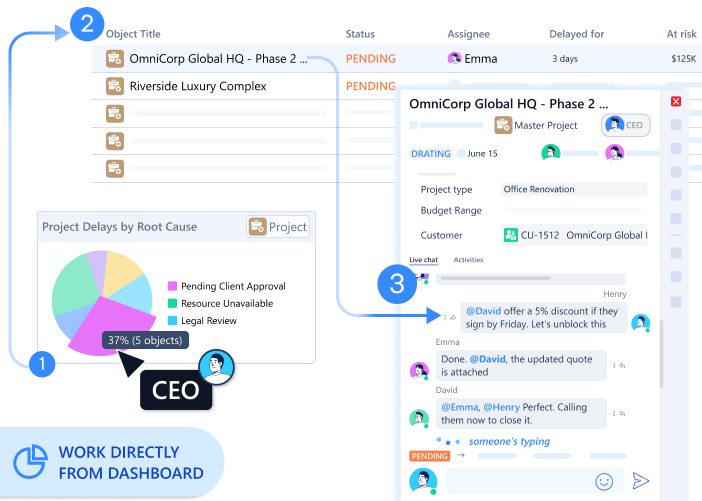
When conversation attaches to work objects, collective intelligence becomes visible across the organization.
LAIKA discovered their most successful projects shared a pattern: sustained conversation density throughout execution. Projects with regular discussion—questions asked, decisions debated, trade-offs discussed—delivered better outcomes than projects with sparse communication.
They couldn’t have seen this when conversations happened in Slack. The pattern only emerged when discussion history lived on project objects, visible to anyone analyzing project performance.
Similar discoveries:
- Support tickets with extended discussion threads resolve faster—because context stays attached, reducing repetitive question loops
- Projects with conversation gaps (weeks of silence) correlate with missed deadlines—early warning becomes visible
- Customer relationship depth (measured by conversation continuity) predicts renewal probability better than transaction volume
This collective intelligence emerges because conversation becomes structured organizational memory, not ephemeral messaging.
Multimodal Context
Unified Livechat doesn’t just capture text. It becomes the medium for all object-related communication:
- File context. Share a design mockup in project chat. It attaches to the project automatically. Six months later, someone asks, “What was our initial concept?” Open the project. Scroll the chat. The file is there.
- Decision history. “Why did we choose vendor B?” Search project chat. The conversation where that decision happened appears—complete with the comparison table someone pasted in.
- Status narrative. Watch a project’s chat thread over time. It’s a complete narrative of how the work evolved—who blocked whom, where assumptions changed, when scope crept.
Traditional tools separate communication from artifacts. You discuss in Slack, store files in Drive, track work in Asana. When you need context, you’re reconstructing across three systems.
With embedded chat, the context is atomic. The conversation and the work are one unit.
What Disappears
Several rituals common to fragmented tools simply vanish:
- Status update meetings. When conversation lives on work objects, everyone with access sees the discussion history. The project’s current state is documented in its thread. Status meetings become decision meetings, not information-transfer sessions.
- “Where did we discuss this?” The discussion is permanently attached to the work item it concerns. No searching Slack channels or email folders.
- Onboarding context gaps. New team member joins a project. They read the project conversation history. Two hours later, they understand past decisions, current blockers, and reasoning behind approaches. Institutional knowledge doesn’t evaporate when people leave—it’s preserved on the work objects themselves.
- Cross-timezone coordination overhead. Remote teams use object conversation asynchronously. Paris discusses the project while Ho Chi Minh City sleeps. Morning team reads the thread. Context transfers perfectly without real-time overlap required.
The Architecture That Enables This
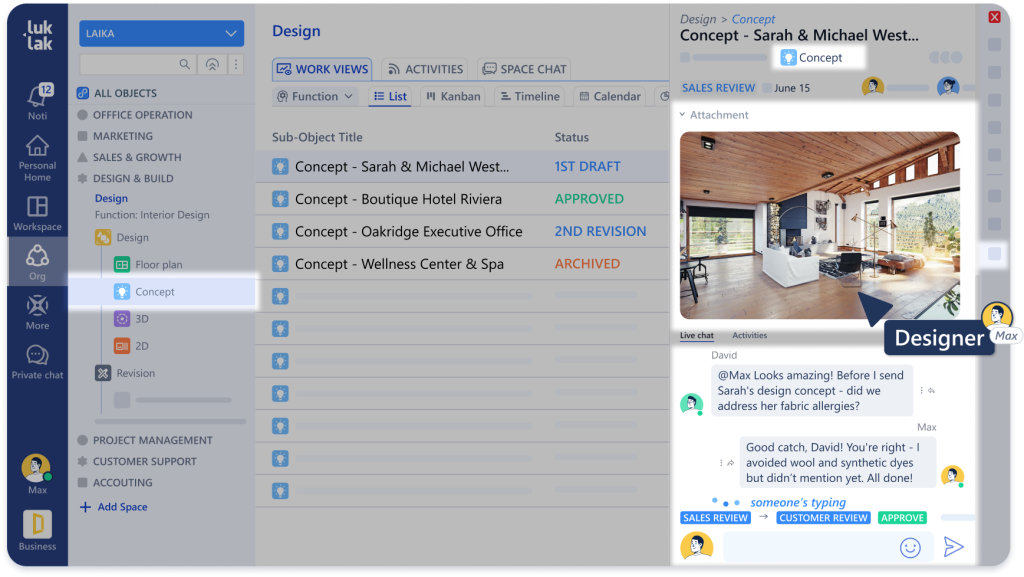
Unified Livechat works because it shares the Universal Object foundation. Conversation isn’t a separate feature—it’s part of the object architecture:
- Same relationship graph. Conversation threads follow object connections. Customer conversation can reference related project discussion. Context links bidirectionally through the relationship network.
- Same work visibility. Leaders see both project status AND the conversation that produced it. Decisions become visible, not just outcomes. Trade-offs get documented, not buried in DMs.
- Permanent organizational memory. Conversations don’t disappear after 90 days (Slack’s free tier limit) or get archived into inaccessible storage. They live on work objects as long as the work exists.
Let’s welcome the marriage of work and chat
When conversation lives on work objects—not in temporary channels—institutional memory becomes architecturally preserved. Discuss the customer ON the customer. Discuss the project ON the project. Six months later, the reasoning is still there.
That’s Unified Livechat. Communication that builds organizational memory instead of losing it.
Next in the series: Universal Automation — How to automate across all your functions without writing integration code.
